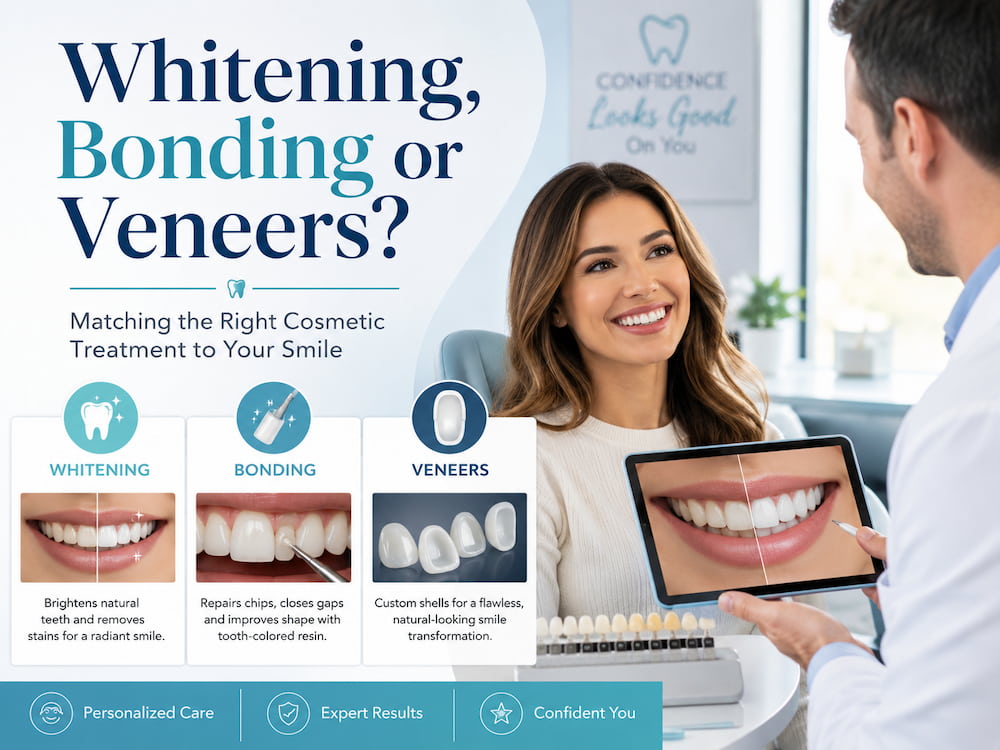
People rarely walk into a consultation asking for a specific procedure. They walk in with a complaint. My teeth look yellow in photos. There is a chip in my front tooth. One tooth sits behind the others. The job of a good cosmetic consult is translating that complaint into the least invasive treatment that actually solves it.
That last part matters more than most patients realize. Cosmetic options are not interchangeable, and some of them permanently change the tooth underneath. Here is how the common treatments compare, and which problem each one is genuinely built for.
Start with the actual complaint
Colour, shape, position and damage are four different problems with four different answers. Teeth that are evenly darkened respond to whitening. A single chipped corner is a bonding job. Teeth that are straight but oddly shaped or unevenly worn are a contouring or veneer conversation. Teeth that are crooked or crowded are an orthodontic problem, and covering them with veneers instead of moving them is the classic expensive mistake.
If you are unsure which category you fall into, take a photo of your smile in natural daylight and one from the side. Patients are often surprised that what bothered them was position rather than colour, or the reverse.
Professional whitening
Best for: overall yellowing and staining from coffee, tea, red wine or age, on teeth that are otherwise healthy and well-aligned.
Whitening removes nothing and changes nothing structurally, which makes it the most conservative option available. In-office systems work considerably faster than drugstore strips because of the concentration used and because a professional applies it while protecting your gums. Take-home trays made from impressions of your teeth are slower but effective, and many practices combine both.
Two limits worth knowing. Whitening does not lighten crowns, veneers or tooth-coloured fillings, so if you have visible restorations, your dentist may need to plan around them. And whitening does not last forever. Expect to top up periodically depending on your habits.
Bonding
Best for: small chips, minor gaps, a slightly misshapen tooth, or exposed root surfaces near the gumline.
Bonding uses tooth-coloured composite resin sculpted directly onto the tooth and hardened with a light. It is usually done in one visit, needs little or no removal of natural tooth, and is the most affordable of the cosmetic options. The trade-off is durability. Composite stains over time and chips more easily than porcelain, so bonding typically needs replacing sooner than a veneer would.
Veneers
Best for: multiple front teeth with a combination of issues, or discolouration that whitening cannot touch, such as tetracycline staining or a tooth that darkened after trauma.
Veneers are thin porcelain shells bonded to the front of the teeth. They handle colour, shape and small alignment issues simultaneously, which is why they dominate smile-makeover conversations. They are also the most significant commitment on this list, because most veneers require removing a layer of enamel, and enamel does not grow back. Once a tooth is prepared for a veneer, it will need one indefinitely.
That is not a reason to avoid them. It is a reason to be certain before starting, and to ask whether a more conservative sequence, such as aligning first and whitening after, would get you most of the way there.
Clear aligners
Best for: crowding, spacing, and mild to moderate bite issues, particularly in adults who do not want visible brackets.
Straightening is frequently the right first move rather than the alternative to cosmetic work. Aligned teeth photograph better, clean more easily, and often reduce how many veneers you would need afterward. Treatment takes months rather than a single appointment, which is the main reason people skip it, but the result is your own teeth in better positions rather than restorations you maintain for life.
Questions to ask at a cosmetic consult
Ask what the most conservative option for your case is, and why the dentist is or is not recommending it. Ask how much natural tooth structure the plan removes. Ask to see before-and-after photos of the dentist’s own patients rather than manufacturer stock images. Ask how long the result should last and what maintenance it needs. Ask what happens if you do not like the shade or shape once it is done, and whether you will see a mock-up or trial smile first.
If you are weighing options locally, W Dental, a practice led by Dr. Carly Klassen just off I-20, offers a free cosmetic consultation, and their is a useful way to see finished cases before you commit. Anyone researching a cosmetic dentist in Willow Park, TX can start there and compare approaches.
The bottom line
The best cosmetic plan is usually the one that solves your specific complaint while removing the least amount of your own tooth. Get clear on what actually bothers you, ask what the conservative path looks like, and be skeptical of any plan that jumps straight to the most extensive option before anything gentler has been discussed.
Did you find this helpful? Check out our other helpful articles on our website.
Read Also
- Where to Find Reliable Mental Health Support for Teens
 Have you noticed changes in your teen’s mood, sleep, or behavior that leave you worried? Growing up can bring stress from school, friends, family, and new demands. Some teens may struggle to share their feelings or ask for help, even when they need support. Finding the right mental health support for teens can help them… Read more: Where to Find Reliable Mental Health Support for Teens
 - Top Trends Shaping the Future of Mental Health CareMental health care is moving fast to meet daily human needs. People want direct care that fits modern life. Clinics respond by creating flexible options that make healing easier to reach. Providers look past rigid habits to give people solid care. From smart tools to body wellness, these changes help people find relief when life… Read more: Top Trends Shaping the Future of Mental Health Care
- Full-Arch Dental Tourism: Why UK Patients With Severe Bone Loss Are Looking AbroadDental implants have become one of the fastest-growing segments of private dentistry. Within that market, one patient group behaves very differently from the rest: people who have been told they do not have enough upper jawbone for conventional implants. For these patients, the choice is rarely between one clinic and another. It is between a… Read more: Full-Arch Dental Tourism: Why UK Patients With Severe Bone Loss Are Looking Abroad
- Levels of Mental Health Care and When to Seek SupportMental health care can range from occasional outpatient appointments to 24-hour hospital treatment. The appropriate level depends on safety, symptom severity, daily functioning, medical needs, available support, treatment history and personal preferences. A licensed clinician should assess these factors rather than relying on a symptom list alone. Need help now? In the United States, call… Read more: Levels of Mental Health Care and When to Seek Support
- How to Choose a Shilajit Brand Based on the ResearchIn a randomized trial published in the Journal of the International Society of Sports Nutrition in 2019, 63 active men took 250 mg of standardized shilajit, 500 mg, or a placebo every day for eight weeks, and the benefit for strength retention after a fatiguing workout appeared only at 500 mg. For anyone choosing a… Read more: How to Choose a Shilajit Brand Based on the Research
- How to Incorporate Relaxation into Your Busy ScheduleFinding balance when you have a packed daily agenda often feels out of reach. Between work duties, family obligations, and personal projects, personal rest usually gets pushed to the bottom of the list. Small, intentional shifts in daily habits can help restore calm without requiring hours of extra free time. Continue reading to discover everything… Read more: How to Incorporate Relaxation into Your Busy Schedule
- Red Light Therapy for Skin and Wellness: Meet Vital Red Light TherapyModern wellness is not always about complicated treatments or long routines. Many people are now looking for simple, convenient ways to support their skin, recovery, and overall wellness at home. One technology getting more attention is red light therapy. Red light therapy uses specific wavelengths of red and near-infrared light to support the body’s natural… Read more: Red Light Therapy for Skin and Wellness: Meet Vital Red Light Therapy
- Managing Shock Loss After a Hair Transplant: The Financial and Clinical Imperative of Post-Op CareIn the rapidly evolving landscape of private healthcare, executive leadership within cosmetic and restorative surgery clinics faces a dual challenge: maintaining strict clinical standards while maximizing patient lifetime value (LTV) and brand advocacy. As the global medical tourism and elective procedure markets expand, clinical outcome quality alone is no longer the sole differentiator for premium… Read more: Managing Shock Loss After a Hair Transplant: The Financial and Clinical Imperative of Post-Op Care